




Seven products. One press sheet.
The seven CMYK2 products cover the print and packaging lifecycle: concept, artwork and prepress, compliance and launch, estimating, print-shop operations, press scheduling and shop-floor data. Two closed loops run through them.
| Product | Plate | What it does | Design target |
|---|---|---|---|
| NPD | CCreate | Pack concept directions from a brief, composed onto your dieline. | TargetConcept job in under a day, against 3–6 days from scratch |
| Packaging Studio | CCreate | A browser-based packaging artwork editor with prepress built in. | Target60 artwork files in minutes (3 sizes × 5 flavours × 4 markets) |
| APMS | MMatch | Artwork compliance, proofing and approvals for every SKU and every market. | Target12-week launches in 3 |
| Print Estimation | KKey numbers | Deterministic print and packaging estimates, with a margin guard on every quote. | TargetMargin-guarded quotes in minutes |
| Operix Print | KKey numbers | Print-shop operations on one system, from prepress job to dispatch. | TargetJob margin on the day the job runs, not six weeks after month-end |
| PressPilot | YYield | Finite-capacity press scheduling with a real constraint solver. | TargetMake-ready −28% |
| PressConnect | YYield | Shop-floor data from any press, turned into one event stream and honest OEE. | TargetLive OEE from any press, even a 30-year-old one |
Figures tagged Target are design targets taken from our product specifications. They describe what each product is engineered to deliver; they are not reported customer results.
NPD
Pack concept directions from a brief, composed onto your dieline.
Concept rounds burn weeks, and the winner dies in production.
Generates concept directions from the brief across selectable creative territories, writes the pack copy, builds size × flavour variants and composes everything onto your dieline.
More directions to choose from, sooner, already on the dieline and ready for a designer to refine.
- Structured brief intake: product, targets, claims and markets
- Competitor and trend research, stored with every job, plus a white-space read of the category
- Concept directions across up to 18 creative territories; the designer curates rather than starting blank
- Dieline reader: choose a preset, upload one, or extract it from a photo
- 2D and 3D pack previews before any file is built
- Packaging copy and the design rationale, captured for the client
- Size × flavour variants from the chosen concept; CMYK soft-proof preview
- Layered SVG and press PDF export, and a hand-off into Packaging Studio
- Feasibility checks against your substrates, machines, tooling and MOQs
- Cost-target and regulation checks at concept stage
- A searchable knowledge base across every job
Packaging Studio
A browser-based packaging artwork editor with prepress built in.
Every variant is rebuilt by hand, and prepress problems surface at the printer.
One master artwork drives every variant, while preflight, trapping, separations and PDF/X-4 export run inside the same editor.
Print-ready files that come straight from the artwork, with fewer round-trips to prepress.
- Editor: layers, pen and Bézier, Pathfinder, gradients including mesh, text on path, clipping masks
- Dieline overlay with bleed and safe-zone guides; SVG, PDF, AI and EPS import
- Variant matrix: one master to size × flavour × market, batch-exported as a ZIP
- AI design agents for layout, typography, colour, copy and localisation; brand colours governed by ΔE
- Preflight, including vendor-aware printer profiles
- Automatic trapping: choke and spread, presets for offset (coated and uncoated), flexo, gravure, digital
- Overprint and auto-overprint black, ink-coverage and rich-black checks, separation preview, imposition
- PDF/X-4 export with ICC OutputIntent (ISO Coated v2 / FOGRA39, GRACoL 2013) and a conformance check
- CIEDE2000 ΔE colour governance; spot colours in Lab and HKS
- On-pack checks: FSSAI, Legal Metrology, BIS, EU 1169/2011 allergens, US nutrition panel, Brazil ANVISA
- EAN-13 and EAN-8 check digit and quiet-zone validation
- Foil, emboss and spot-UV finish previews; CFF2 dieline export; share-link review and approvals
- RIP and screening
- Advanced vector tools (offset path, text wrap, symbols)
- Verified round-trip editing in desktop design tools
- Image resolutionAll placed images ≥ 300 ppi at final size
- BleedBack panel artwork stops 1 mm short of the 3 mm bleed
- Safe zoneNet-quantity text sits 1.5 mm from the fold
- RGB in a CMYK jobOne placed photo is still RGB
- Total ink coverageRich black reaches 320% on the side panel
- FontsAll fonts embedded and licensed for print
- Minimum text sizeMandatory text at or above the legal minimum
- Barcode quiet zoneEAN-13 check digit valid; quiet zone clear
- Overprint blackBlack text set to overprint
- TrappingSpread applied where magenta meets yellow (offset coated preset)
- PDF/X-4 conformanceRe-check after fixes: OutputIntent FOGRA39
APMS
Artwork compliance, proofing and approvals for every SKU and every market.
A launch is a hundred emails and one hero project manager, and the slip is found at the gate review.
Checks artwork against versioned rule packs, reads the text off the artwork itself, routes approvals through gates, and finds every SKU a rule change touches.
Every gate has an owner and an evidence trail, and a rule change stops being a surprise.
- Rule packs for India (FSSAI, Legal Metrology, BIS, EPR), EU (FIC 1169/2011, CLP, PPWR), UK (UK FIC, Natasha's Law, UKCA, GB CLP) and global (Codex, GHS, GS1 GTIN, ISO symbols)
- Rules versioned with effective dates
- Proofing: outlined-text reading, text against approved copy, barcode and Braille checks
- Nutrition rounding, including US FDA 21 CFR 101.9
- Instant Audit: upload legacy artwork, get a cited multi-market compliance report
- Workflow with approval gates, e-signature records and change requests
- Rule change → every affected SKU and artwork
- Twelve coordinated agents (brief, compliance, copy, launch, localisation, prepress, risk, SKU, variant, visual QA, workflow and an orchestrator) prepare the work; people set policy and approve
- Hash-chained, append-only audit trail
- A full US label pack
- A live regulatory feed
- Connectors to SAP, PIM and DAM systems
- Launch critical-path planning across gates
Print Estimation
Deterministic print and packaging estimates, with a margin guard on every quote.
Quotes come off an old rate card: you win the job and lose the margin.
Costs the job from its spec (imposition, make-ready, wastage, finishing and machine-hour rates) and blocks or flags any quote below your margin floor or far from your price history.
Every quote goes out with its assumptions beside the price, and none slips under your floor unseen.
- Job-spec costing: substrate, GSM, sheet size, colours, ups, make-ready, wastage and finishing
- Finishing: lamination, UV, foil, emboss and deboss, die-cut, folder-gluing (straight, crash-lock, 4- and 6-corner), window patching
- Sheet-fed, reel-fed and corrugated; flute grades A, B, C, E, F, BC, EB
- Templates: mono and folding cartons, rigid boxes, labels, paper bags, books
- Optimiser: cheapest sheet and orientation, ganging proposals
- Margin guard: pass, warn or block on margin floor, price deviation, ups waste and machine-rate variance
- RFQ emails and attachments read into a draft estimate for review
- Price memory learned from the quotes you win
- GST-ready quote documents (CGST, SGST, IGST) and quote-to-order hand-off
- The self-learning quote: floor actuals written back into machine-hour rates, make-ready and spoilage
- Capacity and material checked at quote, with PressPilot
Rules shown: margin floor 18% (warn below), block below 10%, and a warning when the price is more than 15% away from your last five accepted quotes for similar work. Print Estimation is deterministic: it costs from imposition, make-ready, wastage, finishing and machine-hour rates; no language model sets a price.
Operix Print
Print-shop operations on one system, from prepress job to dispatch.
Margin is known six weeks after the month, and every department has its own number.
Brings prepress jobs, plates and dies, the ink kitchen, production, quality, dispatch and job work onto one record, on the Operix core.
One record of every job, so the margin question finally has one answer.
- Prepress job records: preflight status, separations, imposition (step-and-repeat, work-and-turn, work-and-tumble), PDF/X-4, X-1a and X-3 targets
- Plate, die and block library: CTP, conventional, flexo and gravure plates, with lifecycle
- Ink kitchen: formulations, mixing batches, Pantone, HKS and RAL references, target and measured Lab with ΔE tolerance
- Production planning: machines, schedules, changeover rules
- Quality: incoming, in-process, first-piece and final inspection
- Dispatch: packing list, delivery challan, e-Way Bill records
- Job work and outsourcing: sub-contractor POs and job-work challans
- Packaging lifecycle: specifications, artwork versions, regulatory regime
- Job margin and OTIF per job
- Reverse-costing: actual against quote on every job
- Cash-cycle view
PressPilot
Finite-capacity press scheduling with a real constraint solver.
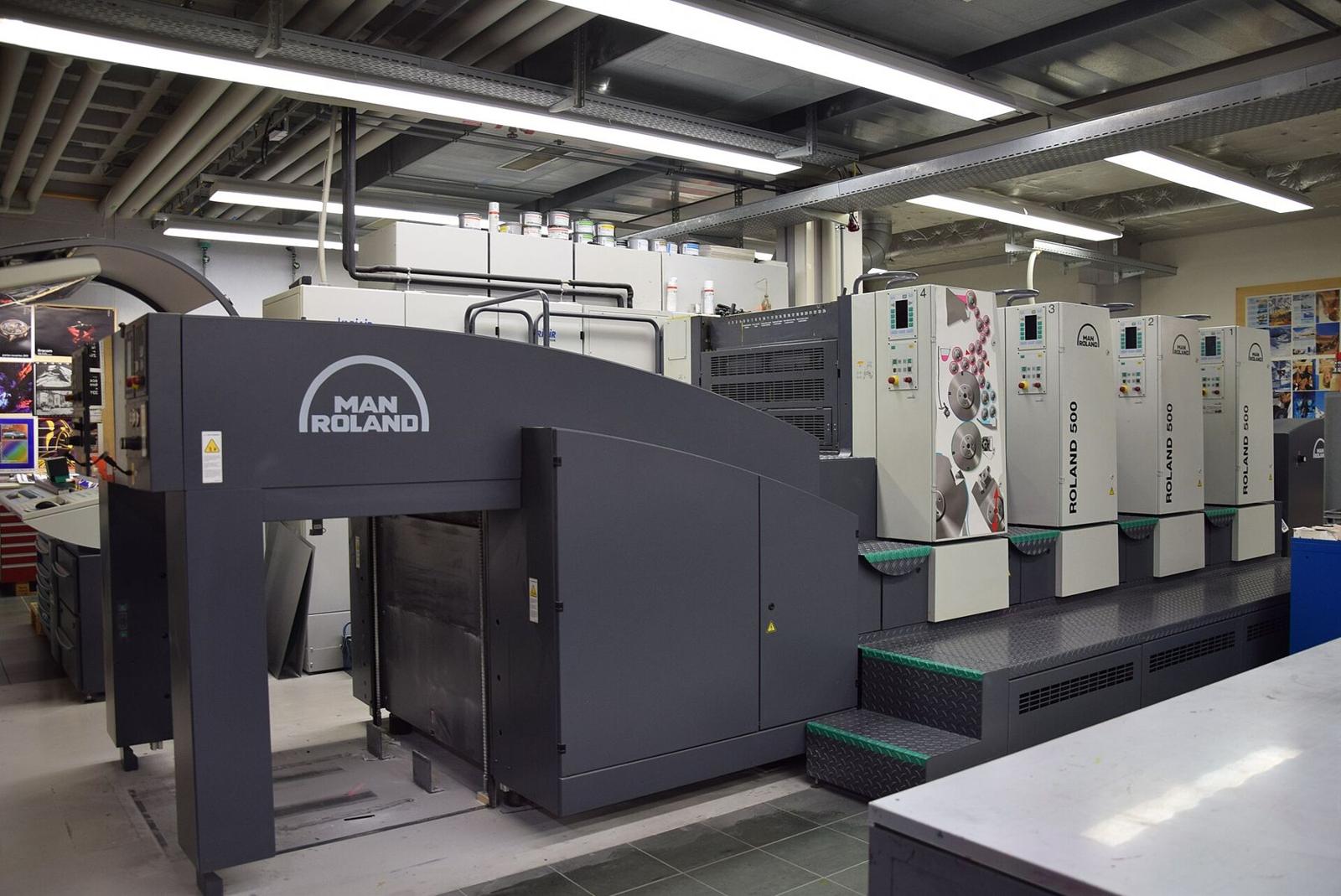
The press runs a paper list (dark, light, dark) and washes ink all shift.
Sequences jobs with Google OR-Tools CP-SAT against your own changeover table, holds a job until its board and ink are in, respects calendars and multi-stage routes, and records every promised date against the actual finish.
Fewer avoidable changeovers, and an on-time rate you can actually see.
- CP-SAT job-shop scheduling, not a rules board
- Per-tenant changeover table: substrate, ink, plate, colour, coating, board, with readable labels
- Material gate: stock and PO arrival, with spoilage included
- Shift and holiday calendars; multi-stage routes (print → die-cut → fold-glue)
- Due-date promises and a lateness objective
- Promise-reliability ledger: promised against actual, your real on-time rate
- Jobs imported from Excel; a planning-board prototype
- Offset, gravure and flexo routing (folding carton and finishing are modelled first)
- Capacity reserved at quote: dates the plant can hold
- What-if and change-impact before you commit
- Live re-solve from floor actuals
- Running inside Operix, or beside SAP, Tally or Accura
- Crew constraints
| Change | From → to | Make-ready |
|---|---|---|
| Substrate | 300 gsm SBS → 350 gsm FBB | 12 min |
| Ink | Light → dark (no wash) | 6 min |
| Ink | Dark → light (wash-up) | 25 min |
| Plate | New plate set (4C) | 18 min |
| Coating | Aqueous → UV | 20 min |
| Board | Same board, new die | 15 min |
PressConnect
Shop-floor data from any press, turned into one event stream and honest OEE.
Nobody knows the real set-up time, speed or waste until the month is over.
Takes whatever a press can give (connected protocols, PLC registers, end-of-job reports, retrofit sensors or an operator's two taps) and turns it into OEE, downtime and severity signals.
Actual set-up, speed and waste per machine and substrate, ready to feed planning and estimating.
- Five ways in: connected presses (built for JDF/JMF, OPC UA, MQTT), PLC registers (Modbus), end-of-job PDF/CSV reports, retrofit sensors, a two-tap operator app
- OEE = availability × performance × quality, against planned production time, by press, shift and job
- Downtime and planned downtime; a data-quality trust score
- Severity gate: ignore, alert, or re-plan
- Planning memory: actual set-up, speed and waste by machine × job class × substrate
- Read-only and outbound-only, with an on-site buffer so a power cut doesn't lose a shift
- Floor, OEE, downtime and alert screens
- Protocol clients proven on presses in the field
- Actuals feeding the estimate and the schedule automatically
- A self-healing schedule with PressPilot
See one of them on your own jobs.
Bring a real artwork, a real quote or a real week of the press schedule. We'll walk it through the product that owns it.